
Experimental Design: Evaluating your Business Risk and its Implications for Design - Part 2/4
Aug 23
/
Manisha Arora & Julian Hsu
In a previous blog post on the big questions around experimental design, we talked about the importance of thinking through different aspects of an experiment.
This will give us the tools to decide how long an experiment should last and how much confidence we should give to the experimental results. Today we will be talking about this second point.
Often, we use results from an experiment to make a decision. For example, whether to roll out a pilot marketing campaign world wide, or start using a test ML model in multiple places on your website.
Since data is always noisy, there is always some risk, however miniscule, that the results from an experiment are driven by noise. Using experiments means we embrace that risk and think through how much risk we are willing to take on depending on the situation.
Here are two extreme examples:
1. When the risk of launching is high:
You are working on a start-up’s first marketing campaign. Your scrappy and dedicated team wants to experiment with two campaigns to launch to decide which to launch worldwide. One is a historically proven campaign strategy in the industry, and the other is an expensive out-of-the-box approach that would potentially grant huge yields if it is successful. The first campaign for a start-up is pivotal to its future success. Given the out-of-the-box approach is more expensive and could potentially fall through, the risks of launching it are large.
Here are two extreme examples:
1. When the risk of launching is high:
You are working on a start-up’s first marketing campaign. Your scrappy and dedicated team wants to experiment with two campaigns to launch to decide which to launch worldwide. One is a historically proven campaign strategy in the industry, and the other is an expensive out-of-the-box approach that would potentially grant huge yields if it is successful. The first campaign for a start-up is pivotal to its future success. Given the out-of-the-box approach is more expensive and could potentially fall through, the risks of launching it are large.
2. When the risk of not launching is high:
You are working at an established company selling breakfast foods. A rival company’s new cereal product is starting to dominate the cereal part of the breakfast foods market, and your team decides to run new marketing around its cereals. You are running an experiment to see whether this marketing campaign would regain control of the cereal part of the breakfast food market. In this case, the cost of being wrong is low because the cereal market is a small part of the breakfast foods market.
Based on these examples, we would say it is relatively more risky for a start-up to put all its bets on a moon-shot project, compared to a more established company. Risk should be based on your key metrics. If your experiment is trying to impact customer churn, for example, you want to think through how much of your customer base you are willing to risk based on the decision you will make based on the experiment.
You are working at an established company selling breakfast foods. A rival company’s new cereal product is starting to dominate the cereal part of the breakfast foods market, and your team decides to run new marketing around its cereals. You are running an experiment to see whether this marketing campaign would regain control of the cereal part of the breakfast food market. In this case, the cost of being wrong is low because the cereal market is a small part of the breakfast foods market.
Based on these examples, we would say it is relatively more risky for a start-up to put all its bets on a moon-shot project, compared to a more established company. Risk should be based on your key metrics. If your experiment is trying to impact customer churn, for example, you want to think through how much of your customer base you are willing to risk based on the decision you will make based on the experiment.
From a statistics (frequentist) perspective, we can describe these two risks from making the wrong decision as False Positive Errors and False Negative Errors, respectively.
- A False Positive Error is when you conclude not to launch treatment, but you should have.
- A False Negative Error is when you conclude to launch but you should not have.
How big False Positive or False Negative errors are varies from one context to another (see examples above). But once we know how big the risks are, we need to decide how likely we are willing to make these wrong decisions
- A False Positive Error is when you conclude not to launch treatment, but you should have.
- A False Negative Error is when you conclude to launch but you should not have.
How big False Positive or False Negative errors are varies from one context to another (see examples above). But once we know how big the risks are, we need to decide how likely we are willing to make these wrong decisions
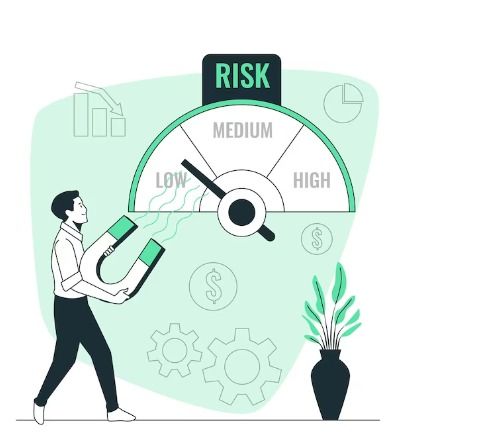
Based on these examples, we would say it is relatively more risky for a start-up to put all its bets on a moon-shot project, compared to a more established company. Risk should be based on your key metrics. If your experiment is trying to impact customer churn, for example, you want to think through how much of your customer base you are willing to risk based on the decision you will make based on the experiment.
From a statistics (frequentist) perspective, we can describe these two risks from making the wrong decision as False Positive Errors and False Negative Errors, respectively. A False Positive Error is when you conclude not to launch treatment, but you should have. A False Negative Error is when you conclude to launch but you should not have. How big False Positive or False Negative errors are varies from one context to another (see examples above). But once we know how big the risks are, we need to decide how likely we are willing to make these wrong decisions
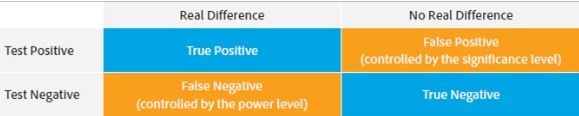
Yes, there is always a chance that you make a wrong decision because noise in your data may have you draw the wrong conclusion. Deciding how likely you are to make these wrong decisions in the experiment reflects how risk averse you are. The higher the rate, the more risk-loving you are.
The lower these errors are for the experiment, the higher confidence we will need from our experiment to have us decide to launch. There are established rules of thumb for False Positive and False Negative Error rates:
- False Negative Rates are 20%: this means that 20% of the time when treatment and control are different, we will incorrectly conclude that they are the same
- False Positive Rates are 5%: this means that 5% of the time when the treatment and control are no different, we will incorrectly conclude from the experiment they are different.
Today we showed how to translate the business risks of making decisions into statistical concepts: the False Positive Rate and False Negative Rate. Determining these rates when we design our experiment forces us to think through how much risk we are willing to take on when we make the decision.
These risks are unavoidable because our data are noisy. But there are strategies we can use to remove some noise from our data before we thinking through the risk. Our next blog post will cover how to reduce the noise in your data and make more precise decisions.
About the authors
Manish Arora
Lead Data Scientist,
Google
Lead Data Scientist,
Manisha has 10+ years’ experience in Data Science. She is the Experimentation Lead at Google Ads. Manisha is passionate about coaching aspiring Tech Professionals and has coached 300+ data scientists over the past 4 years.
Julian Hsu
Senior Economist,
Amazon
Senior Economist,
Amazon
Julian is an innovative and approachable economist with 14+ years of machine learning, experimentation, and causal ML models. With 6+ years of cross-functional collaboration, he works with product, science, and tech teams to launch productionized solutions.

Copyright © 2022
Contact Us!
Got a question? Reach out to us and we will get back to you ASAP!
Thank you!
One more step!
Just a few details before you can download the resources.
Thank you!
Download your resource here
Download your resource here
One more step!
Just a few details before you can download the resources.
Thank you!
Download your resource here
Download your resource here
By submitting this form, you consent to abide by the Privacy Policy outlined by PrepVector.
One more step!
Just a few details before you can download the resources.
Thank you!
Download your resource here
Download your resource here
One more step!
Just a few details before you can download the resources.
Thank you!
Download your resource here
Download your resource here
One more step!
Just a few details before you can download the resources.
Thank you!
Download your resource here
Download your resource here
One more step!
Just a few details before you can download the resources.
Thank you!
Download your resource here
Download your resource here
One more step!
Just a few details before you can download the resources.
Thank you!
Download your resource here
Download your resource here
One more step!
Just a few details before you can download the resources.
Thank you!
Download your resource here
Download your resource here
One more step!
Just a few details before you can download the resources.
Thank you!
Download your resource here
Download your resource here
One more step!
Just a few details before you can download the resources.
Thank you!
Download your resource here
Download your resource here
Access has ended, sorry.
But you can reach out to us at operations@prepvector.com if you need access to the giveaway.
One more step!
Just a few details before you can download the resources.
Thank you!
Download your resource here
Download your resource here
One more step!
Just a few details before you can download the resources.
Thank you!
Download your resource here
Download your resource here
By submitting this form, you consent to abide by the Privacy Policy outlined by PrepVector.
One more step!
Just a few details before you can download the resources.
Thank you!
Download your resource here
Download your resource here
By submitting this form, you consent to abide by the Privacy Policy outlined by PrepVector.
Created with